The Lapis gemstone, centuries ago, was referred to as "Blue Gold" and it has been cherished by mankind for more than five thousand years, be it as jewellery, ornaments, mosaics, paintings or decorative items.
In pre-Middle Ages literature, lapis lazuli was usually referred to as sapphire (or its equivalent)-- e.g., in publications by Theophrastus and Pliny, the Elder. This mistaken identity is so-to-speak perpetuated in many modern Bibles – which seems easily accounted for by the likelihood that commonly used translations of the Bible were by persons with insufficient geological knowledge of the region. In any case, the current name for lapis lazuli appears not to have come into use until the Middle Ages when it was derived from the ancient Persian "lazhuward" (blue) and/or Arabic "lazaward" (Heaven, sky, or blue).
It is one of the biblical gemstones used in Breastplate of Aaron, the High Priest, and at one time Lapis jewellery was only worn by royalty.
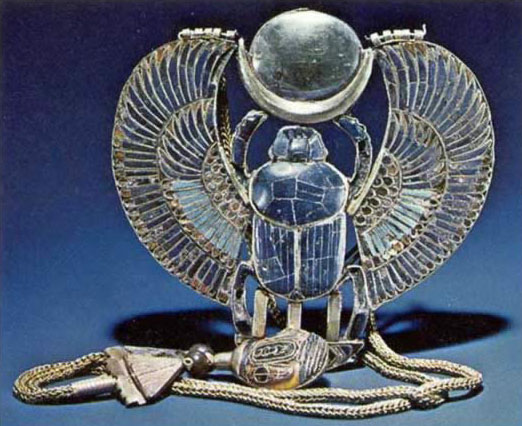 The Egyptians used Lapis for seals, cosmetic purposes and often carved it into vases and figurines.
In many cultures, lapis lazuli was regarded as a holy stone. Particularly in the Middle East it was thought to have magical powers. Countless signet rings, scarabs and figures were wrought from the blue stone in Egypt, which Alexander the Great brought to Europe. In Europe the colourful stone was referred to as 'ultramarine', which means something like 'from beyond the sea'
It is said that the legendary city of Ur on the Euphrates had a lively lapis lazuli trade as long ago as early fourth millennium B.C., the material coming to the land of the two great rivers from the famous deposits in Afghanistan.
The beautiful blues in paintings from the Renaissance are thanks to the blue lazurite of lapis lazuli. Ground lapis was the secret of the blue in ultramarine, the pigment which painters used to paint the sea and the sky until the nineteenth century. Lapis was also popular for inlays.  The columns of St Isaac's Cathedral in Petersburg are lined with lapis and the Pushkin Palace in Petersburg has lapis lazuli paneling!
Chile’s tradition with lapis lazuli dates back to the time of the Chimu tribes that lived in the northern part of the country, and was nominated National Stone on September 20, 1984.