This beautiful stone is technically a rock, not a mineral, because it is made up of various other minerals.
 Lazurite
can be thought of as a product of a chemical reaction between
the mineral nepheline, similar chemically to the common mineral
feldspar, and sodium chloride, NaCl, the mineral halite. As
a common, widespread chemical element, chlorine plays a role
in numerous geo-chemical reactions and appears in many mineral
formulas. Chlorine in lazurite is supplied by sodium chloride.
The "driving force" for this reaction is the heat
supplied by nearby magma. 1
Lazurite
can be thought of as a product of a chemical reaction between
the mineral nepheline, similar chemically to the common mineral
feldspar, and sodium chloride, NaCl, the mineral halite. As
a common, widespread chemical element, chlorine plays a role
in numerous geo-chemical reactions and appears in many mineral
formulas. Chlorine in lazurite is supplied by sodium chloride.
The "driving force" for this reaction is the heat
supplied by nearby magma. 1
Lapis is formed by contact metamorphism which occurs deep below the earth's surface. This natural process occurs when magma finds its way deep into cracks in the earth's crust; the intense heat of the fluid causes chemical changes in the rock surrounding the intrusion creating such beautiful stones as Lapis Lazuli.. 2
Lapis lazuli is characteristically recognized by its distinctive blue colour (due to the Lazurite).
It yields H²S gas (rotten egg smell) when exposed to HCl.
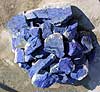 Lapis
lazuli is a rock composed mainly of the following minerals:
Lapis
lazuli is a rock composed mainly of the following minerals:
- Lazurite: (Na,Ca)8(AlSiO4)6(SO4,S,Cl)2
- Hauynite: (Na,Ca)4-8(AlSiO4)6(SO4)1-2
- Sodalite: Na8(AlSiO4)6Cl2
- Noselite: Na8(AlSiO4)6SO4
- Calcite: CaCO3
- Pyrite: FeS2
- Diopside, augite, mica and hornblende may also be present in small amounts
- Class: Silicates
Subclass: Tectosilicates
Group: Both the Sodalite and Feldspathoid groups. 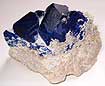 Crystal
Habit: Massive as a rock (Lapis Lazuli) forming mineral,
but dodecahedral crystals have been found of Lazurite.
Crystal
Habit: Massive as a rock (Lapis Lazuli) forming mineral,
but dodecahedral crystals have been found of Lazurite. - Index of refraction: approximately 1.5
- Pleochroism: none (isotropic)
- Specific Gravity: generally 2.7 to 2.9, higher with increasing pyrite content
- Hardness: 5.0 to 5.5
- Durability: sensitive to heat, acid, alkali
- Colour: deep blue, purplish-blue, greenish blue
- Lustre: dull
- Transparency: translucent
- Cleavage: Poor. In six directions, but rarely seen.
- Fracture: conchoidal
- Streak: light blue
- Index of refraction is 1.5
- Wearability: good.